Sarasota East of I-75: One Search Filter, Three Very Different Markets
August 27, 2026
August 27, 2026
The first time a buyer sees a Community Development District assessment, it is usually on a closing statement, not a listing sheet. The home showed a low HOA fee online. The tax bill shows a separate line item that was never part of that conversation, sometimes another $150 to $300 a month, and it is not optional and not negotiable once the purchase is done. That single missed line item is a decent proxy for the bigger problem with how buyers approach the area east of I-75 in Sarasota County: they treat it as one market with one price tag, when it is closer to three markets that happen to share a highway exit.
Drive the corridor bounded by Fruitville Road to the north and Clark Road to the south, and you pass through new-construction communities still pouring foundations, decades-old gated golf enclaves with a fixed and shrinking number of home sites, and acreage parcels where the fence line separates a horse paddock from the neighbor's. A single median price for "east of I-75" averages across all three, which means it tells a buyer almost nothing about what their specific budget actually buys. The more useful question is not what the corridor costs. It is which of the three products a given buyer is actually shopping for.
Here is the rough shape of what sits east of the interstate, organized by what actually differentiates the product rather than by subdivision name alone.
| Segment | What defines it | Example communities | Typical home size |
|---|---|---|---|
| New production communities | Builder-run, phased construction, HOA plus CDD | Skye Ranch, 3H Ranch | roughly 1,180 to 4,000 square feet |
| Low-density golf enclaves | Fixed lot count, established since the 2000s or earlier | The Founders Club, Laurel Oak | roughly 2,000 to 13,000 square feet |
| Acreage and equestrian parcels | Land-first, often no HOA, horses permitted | Deer Hammock, Bern-Creek Ranches, Country Creek | varies widely, built on multi-acre lots |
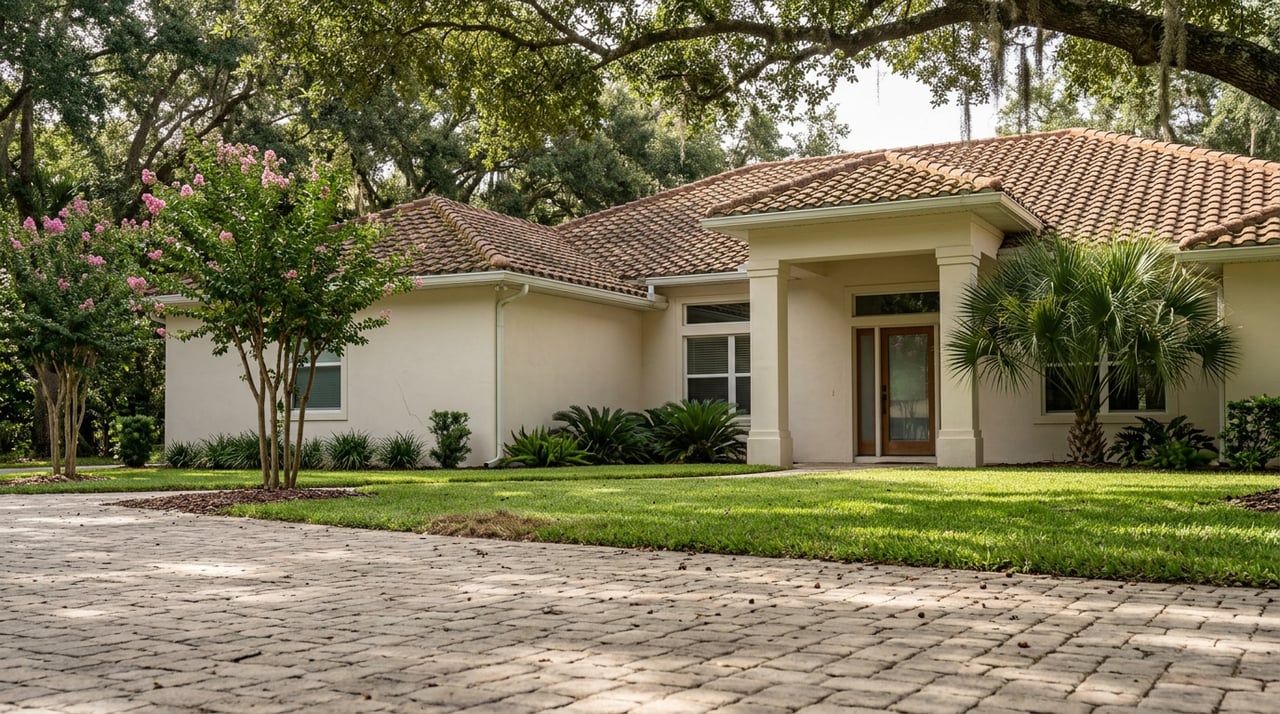
Skye Ranch sits about three miles east of I-75 at Clark and Lorraine roads, an 850-acre Taylor Morrison community split into three sections: Cassia for single-family homes, an age-restricted 55-plus Esplanade section, and a townhome collection built as the lower entry point. The community's own K-8 school opened in 2025. That is a production community in the truest sense: one builder, phased release, a fixed amenity plan, and pricing set by the builder rather than by resale negotiation.
The Founders Club is the opposite instinct. Built around a Robert Trent Jones Jr. golf course on 700 acres, the community was designed around scarcity from the start: 262 home sites, full stop, with roughly 200 of those enjoying a direct golf course view. There is no phase four coming. Home sizes there range from 2,000-square-foot cottages to estate homes between 5,000 and 13,000 square feet, and because the lot count is fixed, the only way inventory changes is through resale.
Then there is the acreage tier, communities like Deer Hammock and Bern-Creek Ranches, built around large lots rather than amenity centers, where the draw is space and, in several cases, the ability to keep horses on the property. These compete with neither of the other two segments. A buyer cross-shopping a Skye Ranch townhome against a Deer Hammock equestrian parcel is not comparing two prices on the same product. They are comparing two different reasons to live east of the interstate.
The CDD surprise at the top of this piece is specific to the first segment, the new production communities, and it is worth understanding before it becomes a closing-day problem rather than a shopping consideration.
A Community Development District is a special-purpose local government created under Florida's Uniform Community Development District Act, first enacted in 1980, which allows a developer to issue bonds that fund roads, drainage, utilities, and amenity construction inside a new community. Buyers repay those bonds through an annual assessment that shows up on the property tax bill as a non-ad valorem line item, separate from the county's regular ad valorem property tax and separate from any HOA statement entirely. That distinction matters because a builder's marketing materials will often lead with the HOA number, since it is the smaller and more flattering figure, while the CDD assessment sits quietly on the tax roll where it is easy to miss during a walkthrough.
The assessment itself has two parts. The bond, or debt service, portion is fixed and amortizes over 20 to 30 years, similar in structure to a mortgage on the community's own infrastructure. The operations and maintenance portion funds ongoing landscaping, amenity upkeep, and lake maintenance, and it does not go away once the bond is retired. As of 2026, assessments on older communities where bonds are partially or fully paid down tend to run in the $1,000 to $2,000 per year range, while newer communities with recently issued bonds run higher, commonly $2,000 to $3,500 and sometimes above $3,500 depending on the amenity package financed. Since the new production wave east of I-75 is, by definition, newer construction with newer bonds, buyers there should expect to land on the higher end of that range rather than assume the smaller, older-community figure applies.
None of this shows up if a buyer only compares the sticker price of a Skye Ranch home to a resale listing in an older, CDD-free neighborhood. The all-in monthly carrying cost is a different number, and it is worth asking for before writing an offer, not after.
The second piece of new-construction friction sits inside the price itself. Builder pricing in these communities is quoted for the structure only. The lot is priced separately as a premium added on top, and that premium can range from roughly $10,000 for a standard interior lot to well over $100,000 for a lot with a water view. A buyer comparing two "starting at" prices between two communities is often comparing two different lot allocations, not two different houses. The number that actually determines what a buyer pays is the base price plus whatever lot premium applies to the specific homesite they want, and that figure is rarely the one advertised in a builder's opening headline.
The clearest evidence that this corridor is not one market is the sheer scale mismatch between its newest project and its most established one. Sarasota County's planning board recommended approval of 3H Ranch back in 2024, clearing the way for a 2,727-acre master-planned community under the county's 2050 plan, with more than 6,500 residential units alongside 250,000 square feet of retail and commercial space and 120,000 square feet of office space, organized around a walkable Village Center rather than a strip-mall layout. Site work began in 2025, and the first homes were expected as early as mid-2026, a window this corridor is inside right now.
Set that next to The Founders Club's 262 total home sites on 700 acres, a number that was fixed when the community was platted and cannot expand. One project is adding thousands of units to the corridor over the coming years. The other has a hard ceiling that resale is the only way in or out. Both sit east of I-75. Neither one tells a buyer anything reliable about what the other costs or how it behaves as a market, which is exactly the point: a single area name does not produce a single supply curve.
Space and price come with a real trade-off, and it is worth stating plainly rather than glossing over. Living east of the interstate generally means a 25 to 35 minute drive to Siesta Key Beach during season, longer than the coastal neighborhoods but shorter than it might sound given the corridor's rural reputation. That distance is shrinking on paper if not yet in daily commute time. The Florida Department of Transportation has fast-tracked reconstruction of the I-75 and Fruitville Road interchange into a diverging diamond configuration, with construction actively underway as part of the state's Moving Florida Forward initiative. Separately, State Road 777, also known as River Road, is under active widening from two lanes to six across roughly five miles between US 41 and I-75, with embankment, drainage, and signal work underway along the corridor. Neither project changes what a buyer pays today, but both are a reasonable signal that the county expects this corridor to keep growing rather than plateau.
Does every community east of I-75 have a CDD fee? No. Older, established neighborhoods and the acreage and equestrian communities are far less likely to carry one. CDDs are concentrated in the newer production communities, which is exactly where a buyer should confirm the assessment before making an offer rather than assuming it does not apply.
Is the CDD assessment negotiable? The bond portion is fixed by the district's own budget and legally enforceable in the same way as delinquent property taxes if unpaid, so it is not something a buyer negotiates directly with a seller. What is negotiable is whether the seller has already paid down the bond, since some listings advertise a paid-off CDD bond as a genuine selling point that lowers the buyer's future carrying cost.
How do I find out if a specific parcel has a CDD before I make an offer? The county tax bill for that parcel will show it as a non-ad valorem assessment line item if one exists. Checking the Sarasota County Tax Collector's records for a specific address before writing an offer is a quick way to confirm the current billed amount rather than relying on what a builder's sales office quotes verbally.
If you are comparing a production home in Skye Ranch against a resale in an established golf community or an acreage parcel with room for horses, the honest answer is that you are not really comparing three prices. You are choosing which of three different ways of living east of the interstate actually fits how you want to spend your weekends. That is a conversation worth having before you tour, not after you have already fallen for a floor plan.
If you are trying to figure out which of these three markets actually fits your budget and your life, First Light Real Estate can walk the corridor with you, pull the real carrying costs on specific communities, and help you compare properties that are not actually competing with each other on paper.
Stay up to date on the latest real estate trends.
September 10, 2026
September 3, 2026
August 27, 2026
August 13, 2026
You've got questions and we can't wait to answer them.