Why Two Homes on the Same Siesta Key Street Can Be Moving in Opposite Directions
September 24, 2026
September 24, 2026
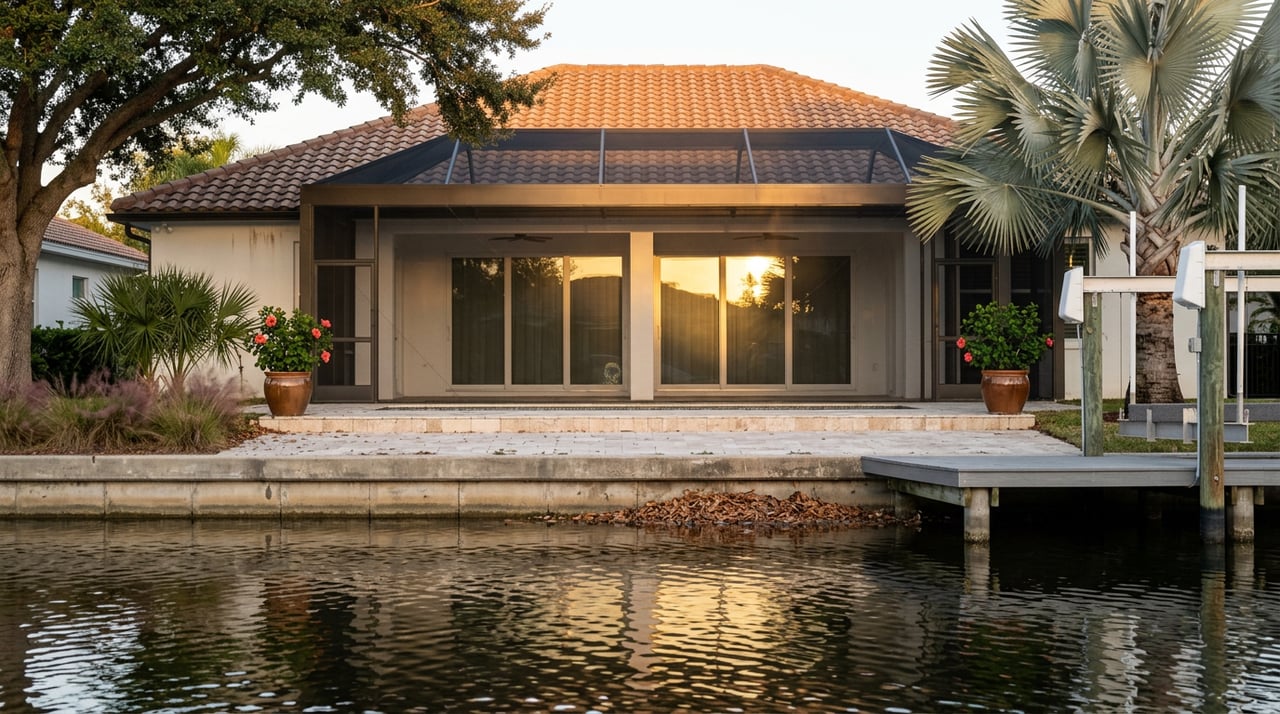
A three-bedroom canal-front house and a two-bedroom beachfront condo two blocks apart can be having completely different years. The house holds its price. The condo sits on the market, gets a price cut, and then loses its financing entirely when a lender takes one look at the building and declines the loan. Both listings say "Siesta Key" in the address. Neither one is behaving like the island-wide median suggests they should.
That median has been getting a lot of attention lately. Redfin put Siesta Key's median sale price at $899,000 over the three months ending May 2026, down 12.6 percent from the same period a year earlier. Zillow's February 2026 figures showed the average home value closer to $810,000, down roughly 9 percent year over year. Read those numbers on their own and you'd assume Siesta Key is simply cooling off across the board. It isn't. The island's single-family homes and its condominiums are responding to two very different pressures, and the condo side of that split has a financing wrinkle that catches buyers off guard more often than any price chart does.
Florida's post-Surfside reforms are the reason. Buildings three stories or taller that are 30 years old or more are now required to complete milestone structural inspections and fund a Structural Integrity Reserve Study, the rule known around the industry as SB 4-D. Siesta Key has dozens of buildings that fall squarely into that window. When an inspection turns up deferred maintenance on a roof, a balcony system, or concrete that wasn't flagged in years past, the association doesn't have the option of waiting. It has to fund the repair, and that usually means a special assessment.
Those assessments run from around $2,000 to $10,000 per unit for routine projects in well-managed buildings. In older buildings with thin reserves, they can spike to $25,000, $40,000, or more per unit for major concrete or structural work. County-wide, condo prices fell roughly 15 percent in 2025, a steeper drop than single-family homes saw, and Siesta Key's inventory leans heavily condo, so the island feels that pressure more than most.
None of this shows up in a listing photo. It shows up in a reserve study and a set of board meeting minutes, which is exactly why so many buyers don't see it coming.
The bigger surprise for a lot of buyers isn't the assessment itself. It's discovering, after they're already under contract, that the building they're buying into is non-warrantable.
A condo building becomes non-warrantable when it fails to meet the standards conventional lenders require for a mortgage to be sold on the secondary market. On Siesta Key, the most common triggers are:
When a building lands on that list, conventional financing disappears. Buyers are left choosing between paying cash or finding a portfolio lender willing to underwrite the building on its own terms, usually at a higher rate. That shrinks the pool of people who can actually buy into that building, which shrinks demand, which is part of why some Siesta Key condo listings sit for months while a comparable canal-front house down the road moves in weeks.
It also explains something else in the data. Cash buyers made up roughly 30 to 40 percent of Sarasota County single-family transactions in 2025, with that share climbing sharply above the $2 million mark. On the condo side, warrantability issues are quietly pushing that cash share even higher in specific buildings, whether the unit is priced at $400,000 or $4 million.
Water access on Siesta Key isn't one product. It's at least three, and the price per square foot tells the story before the flood insurance quote does.
| Water Access Type | Typical Price per Square Foot (2026) | Common FEMA Flood Zone | Typical Annual Flood Premium |
|---|---|---|---|
| Gulf-front house or low-rise | $700 to $1,400+ | VE | $5,000 to $8,000+, higher on high-value homes |
| Bayfront or canal-front | $350 to $550 | AE | $2,500 to $5,000 |
| Inland, near Midnight Pass Road | Below both waterfront tiers | X | Often not required for financing |
The gap between Gulf-front and canal-front pricing, generally 40 to 80 percent for otherwise comparable homes, is the scarcity premium for direct beach access. It isn't really about square footage or finishes. It's about what a lender's flood map says the day you close.
Siesta Key's flood zones aren't evenly distributed, and the geography matters more than most out-of-state buyers expect. The Gulf-facing stretch near Siesta Key Village, at the island's northern end, includes both VE and AE designations. Bayfront and canal-front parcels running along the Intracoastal side are predominantly AE. The lower-risk X zones, where flood insurance isn't a federal requirement for a mortgaged purchase, tend to sit further inland, closer to Midnight Pass Road.
Sarasota County does offer one real cost lever here. The county holds a Class 5 rating under FEMA's Community Rating System, which translates into a 25 percent discount on National Flood Insurance Program premiums for properties in AE and VE zones. It's a meaningful offset, but it doesn't change which zone a specific parcel sits in, and two houses on the same street can carry different zone designations depending on elevation and exact position relative to the water.
Worth remembering: the island being spared the worst structural damage during Hurricane Ian doesn't change how insurers price it going forward. Carriers rate Florida risk by zip code and elevation using catastrophe models, not by what happened in any single storm season.
Before writing an offer on any Siesta Key condo, ask the association for:
None of this lives in the MLS listing. It has to be requested directly, and the answers to those five questions will tell you more about a building's next five years than any amenity list will.
Siesta Key still offers something Casey Key and Longboat Key can't match at the same price point: a walkable village, quartz sand beach recognition, and a broader base of liquidity that comes with more transaction volume. The island isn't correcting because demand for the location has faded. It's correcting because two different products, condos exposed to new structural law and financing friction, and single-family homes that mostly aren't, got bundled into a single median that flattens the difference.
If you're comparing a canal-front house to a beachfront condo on Siesta Key, you're not really comparing two homes at the same stage of the same market. You're comparing two different sets of rules, two different buyer pools, and in some cases two entirely different paths to closing.
Does every condo on Siesta Key need a milestone inspection? No. The requirement applies to buildings three stories or taller that are 30 years old or more. Newer buildings and smaller structures fall outside SB 4-D, though their associations still carry their own reserve and insurance obligations worth reviewing.
Is a non-warrantable building automatically a bad buy? Not necessarily. Some non-warrantable buildings are simply popular with short-term renters, which is a lifestyle and rental-policy issue rather than a structural one. The financing limitation is real, though, and it affects both your purchase and your eventual resale pool, so it's worth factoring into the price you're willing to pay.
Does a favorable flood zone guarantee a lower insurance quote? It helps, but elevation, construction age, and roof condition all factor into the final premium alongside the zone designation itself. An elevation certificate is often the single most useful document for narrowing that estimate before you're locked into a contract.
Numbers on a portal can tell you what Siesta Key's median price did last month. They can't tell you which building's reserve study you should be worried about, or whether the condo you're touring this weekend will finance the way you expect it to. That's the kind of detail that only comes from walking the island, building by building, and knowing which questions to ask before you fall for the view. If you're comparing Siesta Key against the rest of Sarasota's waterfront, First Light Real Estate can help you sort out what the median price won't.
Stay up to date on the latest real estate trends.
September 24, 2026
September 17, 2026
September 10, 2026
September 3, 2026
You've got questions and we can't wait to answer them.